


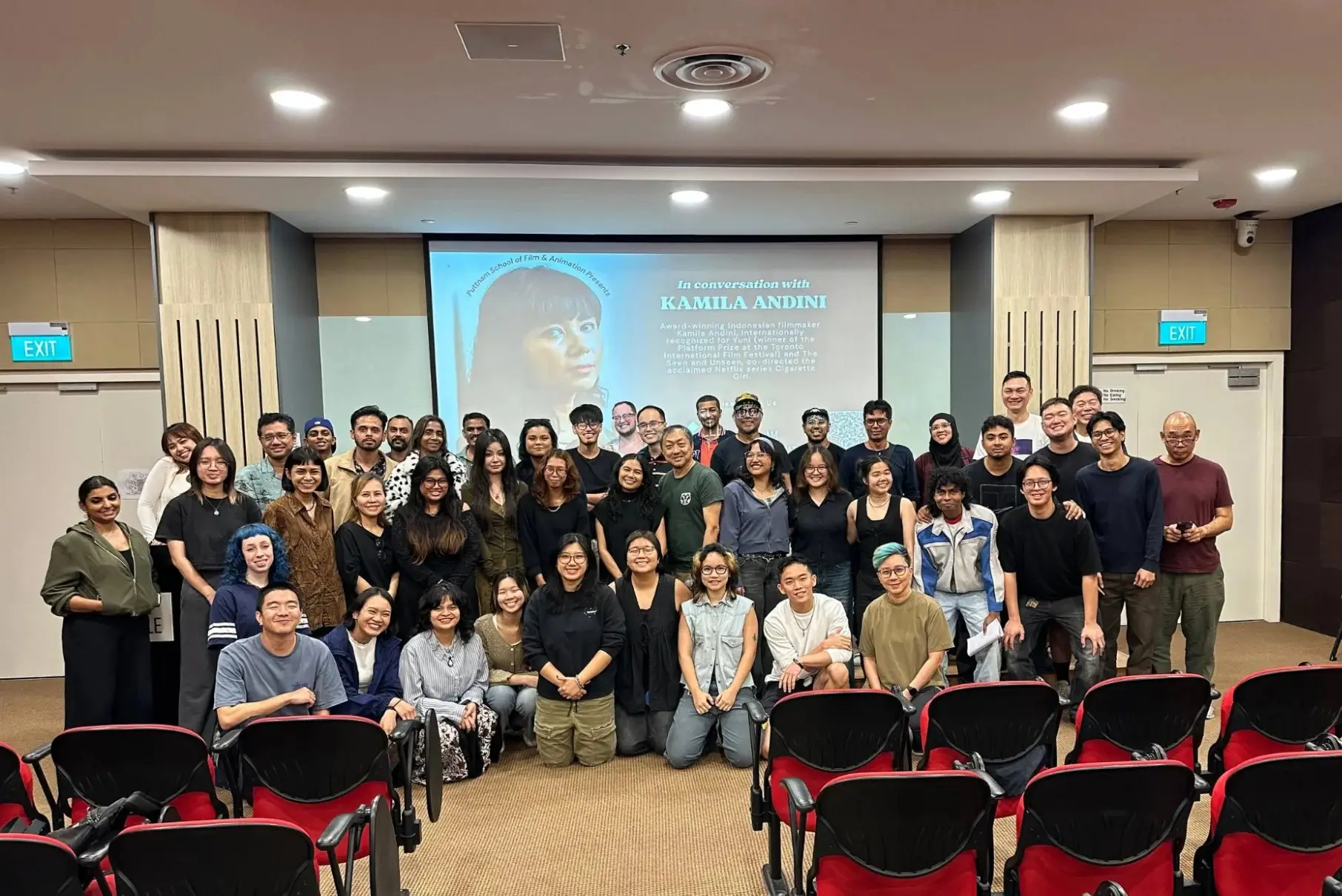
Filmmaker Kamila Andini (centre, middle row) with BA (Hons) Film students and lecturers.
In conversation with: Kamila Andini on filmmaking as a record of personal discovery
31 Aug 2026
Kamila Andini is one of Southeast Asia’s most distinctive voices. From her acclaimed debut feature The Mirror Never Lies (2011), The Seen Unseen (2017), Yuni (2021) and Before, Now & Then (2022) to Netflix’s first Indonesian period series, Cigarette Girl, Kamila puts the spotlight on Indonesia’s diverse cultures with sensitive, female-led narratives.
During her residency at the Puttnam School of Film & Animation earlier this year, Kamila brought that same generosity of vision to her mentorship of final-year students on their graduation films, sharing her invaluable experiences working across both fiction and documentary. Her residency was capped with an ‘In conversation’ session, attended by students and the film community.
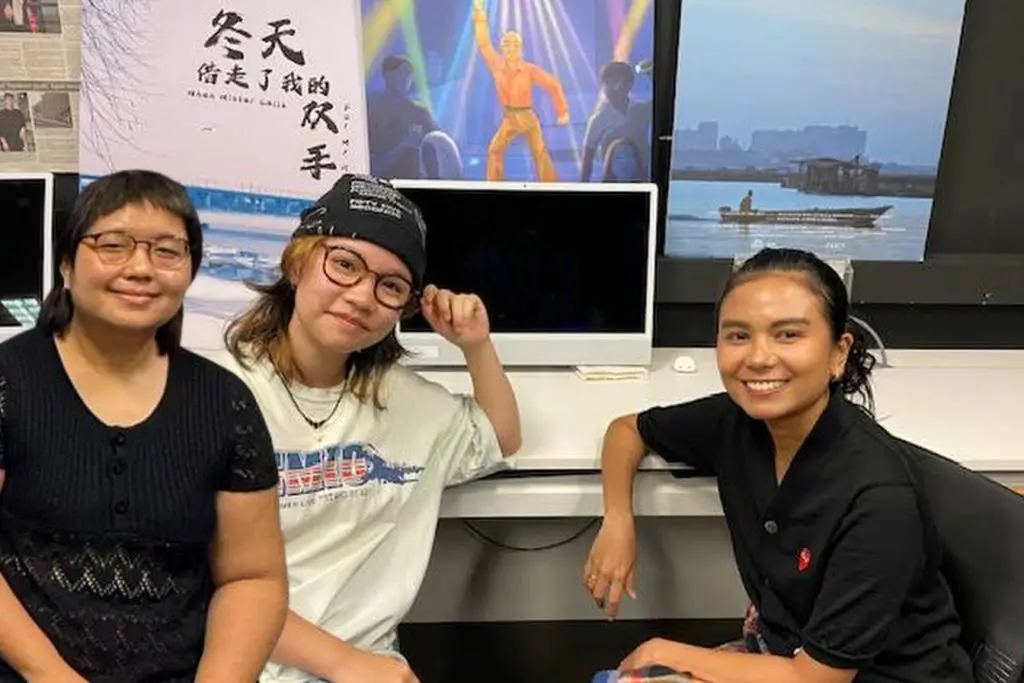
Emma Rose Chow and Pearlyn Kee with Kamila in the classroom.
In this interview, Kamila chats with BA (Hons) Film final year students Emma Rose Chow and Pearlyn Kee about what motivates her storytelling, delving into regional female perspectives on empowerment, representing local cultures for global audiences, and filmmaking as a record of personal discovery.
How would you describe your identity as a filmmaker?
I grew up with my films; every film represents me at that age or phase of life. In a way, I couldn’t make the films that I made earlier now.
My first feature film, The Mirror Never Lies, is a film I could only make in my 20s. The Seen and Unseen was my question about my identity and culture at that time, and how we connect as Indonesians who believe in everything that we believe in that’s not rational.
For quite some time, my main character would always be a woman—even though it was not intentional—and so people started giving me this title, that I make films about women. By that point, what would my voice be, if I intentionally made a film about women? That’s how I made Yuni.
It’s always been about my path and the questions in my mind growing up. It’s different every time. I’m a filmmaker who makes films about my connection to the world, and I want to find myself in each of the films that I make—to understand myself and the world around me.
Your protagonists are women, and your films are very personal to you. What does it mean for you to represent Indonesian womanhood?
I decided to be a friend to the women around me, who are safe to be whoever they want to be. That’s actually what I do in my films: I let the characters become who they are. I’m not the one who’s supposed to judge them or anything that they do. This is my practice for trying to understand more about myself as a woman—a woman in my country, especially.
It began when I started to make films in 2011. In 2015 I studied sociology at a university in Australia, and of course, learned about feminism, but a more Western kind. Most books on feminism come from the Western world. I know that in Hollywood, the woman has to be strong and stand up for herself, but existence is very different as an Indonesian.
Within this culture, women are constantly re-negotiating our positions. Throughout the years, I understood that female identity in Indonesia is also influenced by colonialism, imperialism, religion and everything that happens in our cultural history. It’s much more complex and intersectional.
I want others to understand that women showcase resilience differently in different places in the world, and that we need to support and give voice to these differences.
Do any specific struggles arise from presenting an Indonesian understanding of feminism to the West?
When some of my films are shown in Europe, the feminine representation is debated—they ask, “Where is the strength of this woman?!” They expect a set ‘hero’s journey’, with action due to this or that scene. Some people need to see strength and feel personally encouraged by what they’re watching.
The women in my films are not loud, and they try to find their way through things, and therein I see strength.
The hero’s journey looks very different for survivors or women going through something. I feel there is a dilemma on which one should come first: do I want to make an exciting plotof it, or do I want to be true to my subject? This deep dilemma is always there. I question how honest I want to be all the time. That’s the hardest part.
How do you explore the domestic sphere as a site of female agency and power, rather than it being an oppressive, restrictive space?
Everything for me is about understanding the intersectionality within. It’s not about choosing one side. There are so many ways to define strength. Living in Indonesia with its very patriarchal culture, for women the domestic sphere is sometimes the only space they can show themselves.
Of course I want women to have more than just that space to be. Of course that’s the dream. But I’m amazed by how they keep up the resistance within those limitations. I need to encourage that and acknowledge that as a strength, so we can move forward and expand that space for everyone.
We’d like to ask about the spiritual element of your work, as we watched and loved The Seen and Unseen. How do you bridge the gap between what’s considered real and what’s considered more spiritual or mystical?
With The Seen and Unseen, one of the first questions that I had was: What is surrealism and realism, and what is spiritual and ‘reality’? Somehow, when I see my culture—Balinese culture within which the film is set—there are no borders between the two.
You see surrealism in everyday life. You see spiritualism in reality. It’s blended, and it goes hand in hand. I wanted to capture that.
When you see the treatment of The Seen and Unseen, I’m trying to capture the spirituality and the surrealism that comes within the reality itself, so I went realistic with everything in terms of production design and the way the film was captured. . I think that’s one of the processes. Sometimes what we believe in is not rational, but it’s still blended within our culture.
I want to embrace that we are not rational people, and it’s okay.
There was an intentional visual contrast between the day and the night scenes in that film. We were curious about the motifs with the circles and the eggs.
The film contains a lot of Balinese culture and beliefs. One of them is about circularity, the duality between life and death. It calls to day and night, bright and dark. And the cinematography is very harsh but also soft at the same time. That’s also one of the moments I found my feminine filmmaking aesthetic. I feel that a woman is an ambivalent character. You hold that harshness and softness at the same time, and you forever have that duality within you.
The Balinese also have their own calendar. Life revolves around the moon calendar. The egg is about life as well. There’s always an egg in every offering that they have. The Seen and Unseen’s Indonesian title is Sekala Niskala. It’s a Balinese philosophy where life contains things you can and cannot see, the bad and the good. As a human, what you do is actually to embrace, to hug all the good and the bad things around you. That’s the philosophy that I used as a title.
When I made The Seen and Unseen, I found a lot of myself and how I like to do things in terms of aesthetics and visuals.
How do you find the balance between explaining that side of folklore and cultural history versus just telling the story of your characters and the present moment?
That’s a hard question. I work a lot with my intuition. I cannot explain how I balance them because, as I’m making the film, I have a lot of doubts as well. Maybe because every time I start filming I ask myself, What is it actually that you want to find out?
I wrote The Seen and Unseen (2017) before I got married and had a kid. Between then and The Mirror Never Lies (2011), I loved making stories about kids and talking about things we usually do not talk about with them. Death, for example. You rarely talk about that with kids. It took seven years for me to make that film. After I got married and had my first daughter, I was transformed as a woman after that experience. I read the script, and I was like, “Why do I have a film about kids and death!? I don’t want to face this! This has become too much for me.”
There are times when I don’t touch the script because I feel like it’s not me anymore. But the moment I realised it is not about kids and death, I came back to it. It’s about understanding our beliefs and who we are and how we connect in life. Then I rediscovered that motivation and started to write it again—but this time, the mother was much more present than before.
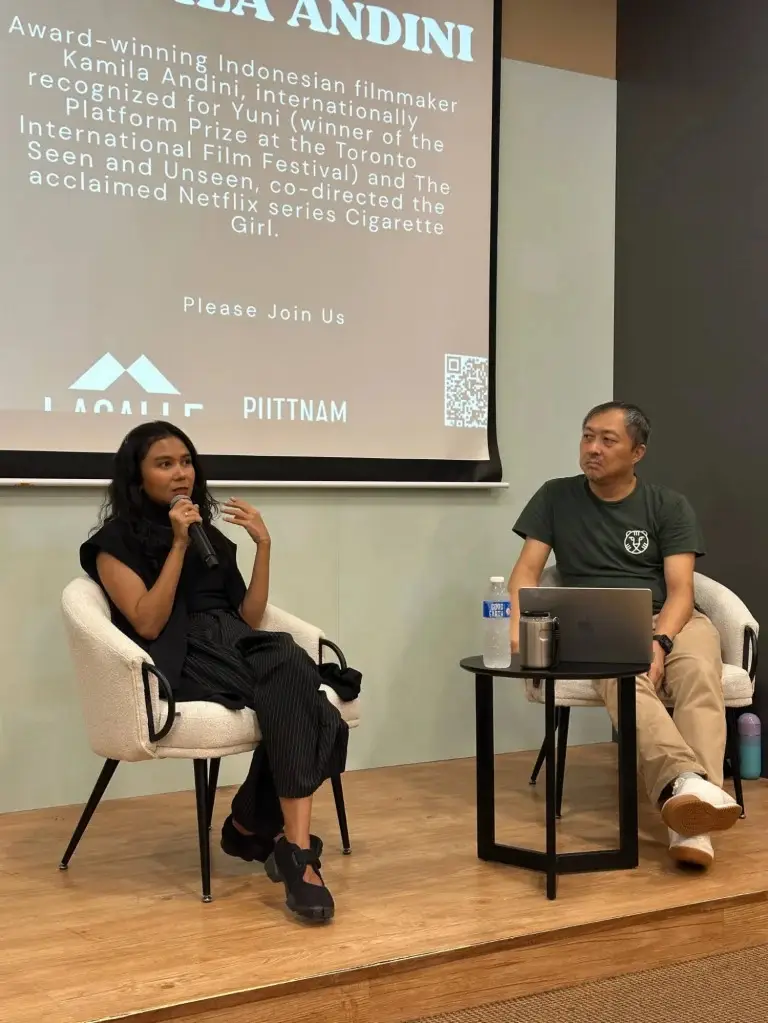
Kamilah gives her presentation to the students of the Puttnam School of Film & Animation, moderated by Lecturer Juan Foo.
Have you any fears and doubts? Are you ever worried that the audience won’t get it, or that maybe you’re not representing your folklore, your culture, truthfully enough?
It’s more the latter. As a filmmaker, you borrow from a subject. My doubts are actually, “What is the best way to tell this particular story and to express very subtle intention? Is this the best way to represent the subject and the character?”
I believe every story needs a different way of telling it. I’m always scared about representation on the screen. Every time I have to represent something, I feel like I don’t know anything, you know? But in that way, I learn all the time as well.
Do you think you’ve found a process to clarify those fears? Do you talk to your team, or do you go back to more research?
All of that. That’s why research becomes one of the most important things for me during development, although sometimes, for producers, it moves backwards and forwards. I have focus group discussions with people knowledgeable about the subject, and I let them read my writing and give feedback, see if there is something that I skipped or missed out. I need a lot of feedback.
Even then I ask myself within the feedback, “Is that what I think? Is that what I want?” I learn a lot from the mistakes I make as well. Sometimes it’s not a mistake, but a perspective coming after the film is already finished. And I learn something new from it. Now I understand more.
How was your experience making documentaries early in your career, and how has it been reflected in your fictional work?
It’s a bit different because my documentaries were not commercial work. I made documentaries for NGOs. I worked a lot with non-professional subjects. Capturing things within reality you can direct a little bit, but you have to be responsive all the time, use your intuition. In the early days, we didn’t have enough resources to get professional actors.
Those documentary experiences helped me to be organic when I respond to and capture things aesthetically. Of course, now I get a chance to make films with much more resources, but the need to stay grounded is always there. Even if I make a fantasy film, I would need it to be grounded in something that I know is real, so I can create that connection. And I think my intuition for groundedness comes from making documentaries. Because in the end, we want to make the audience believe in whatever we are giving.
How do you approach filming that scenery to give it a voice in your stories? What role does it play in your stories to have these visuals?
I love beautiful visuals. Production design is one of the things that I’m consistently very particular and demanding about. [laughing] I don’t know why, but in all of my stories I need to compose the environment like a bubble for the character and the story.
And I really like texture in cinema. I love to put a variety of textures in my visuals.
When you say textures, do you also mean costumes? We’re thinking about the chicken costume in The Seen and Unseen.
Yeah, but also the costumes as juxtaposed against the set. In The Seen and Unseen, for example, we know that they live in a small village within paddy fields in a rural area, but one of the ways audiences should notice it is set in the present day is the material of the house.
I place most of my films around ethnic groups I don’t come from and whose languages I don’t speak. I want you to understand my characters from their backgrounds. Anthropologically, I’m always fascinated by culture.
Textures also mark time…
Time, lives, and culture!
Speaking of culture, do you ever find yourself translating Indonesian culture for a global audience, or do you feel like being focused on your Indonesian culture is the only way to stay true to your story?
It’s a bit of both. Since the beginning, I wanted to tell my story, my character that comes from Indonesia, and for others to understand our people. Yet in another way, when I create I don’t do it to impress someone else. It’s more about what I want to see and find out.
Maybe it’s because I don’t come from the places I feature—I have a foreign perspective=. For me, distance is quite important for any process or story—you are not that close, but you’re also not that far. You know enough, but you’re also not subjective. I always try to find that middle distance between the process and the subject.
You mentioned working with different kinds of people. You’ve done co-productions with Western countries. Do you specifically choose this approach?
I really like that system of international co-production. It fits my approach. I tend to have a lot of doubts, and I have many questions about representation. I need a range of perspectives, even if I do not always use them. I need to digest and think about and decide what I really want in a film.
Having a broad range of collaborators allows me to gather as many perspectives as I can.
Does it ever get overwhelming, all the different people you have to answer to?
In the early days, I struggled because it was not easy for me to articulate my own approach and way of thinking. And up until now, as a creator, the moment you hear criticism, you end up being very defensive about it. But that’s just the process.
Sometimes, a great perspective you hear in the beginning will stay in your mind, and you’ll think about it again, “Maybe that’s right,” or maybe, “That’s—oh, okay, maybe not this, but I can do that in here.” That’s the process of thinking that I always use. And the more I make films, the more I understand the notes that I need.
The thing you said about feedback specifically struck us, just because we are also students and we get a lot of feedback, but it’s so hard to filter down what is really true to the story.
Yeah, and you will experience that for so many years. [laughing] It will never end. Even for me, if I share my story or my film or my rough cut and they say, “Oh, it’s good!”, for me, it’s, “No. I don’t believe it. It’s too good to be true. No, I want real notes, and you can be as harsh as you want because I think that’s better.”
Your recent work, Cigarette Girls—is there anything you learned about yourself or the process whilst working with this new format of television?
Yes, a lot of things. It’s the first time I’ve created for a serial medium. One of the things I love about it is that I have more time to build my characters and conflicts.
I also realised that I treat serials just like I treat feature films. Usually, when people make a series, they’re not as demanding. But for me, I treat it the same. Like, I want everything there and pushed to the limit. That’s why I think the team goes, “Kamila, can you chill? This is not a feature film.” [laughing]
But I don’t compromise. The endurance of energy is different. It’s much more tiring because it is as if you make three movies at one time.
The second thing is that I’m quite lucky that the Netflix team and the production team gave me a lot of room to realise my vision of the story, visuals and characters. I have a lot of freedom to create. I learned how to negotiate, pitch and defend. I think it’s a good experience for me to be able to do that.
There are lots of notes, so many notes. But I usually work within co-productions, so I am used to it, people giving me notes from different perspectives.
Sounds like you got it handled. You just strolled into Netflix, and you were like, “I’m going to make history!”
[laughing] Well, I love new experiences, and I love learning from experience. I believe that even the worst experience is very valuable.
One last question that’s relevant to the idea of mistakes and experience. If you look back on your body of work so far, what lessons could you impart to us students and people who want to do what you do?
I think what’s most important is to find out about yourself. Make sure that you see yourself in whatever it is that you make, even if it’s a commercial. You learn to do that, actually. That’s what I’m still trying to learn and trying to do. Even when I make commercials, I always want to see myself in that particular world.
Thank you so much, Kamila, for sharing your filmmaking experiences with us. It’s been such a pleasure.
You’re welcome! I hope it answers everything.
Related stories
What to expect in LASALLE
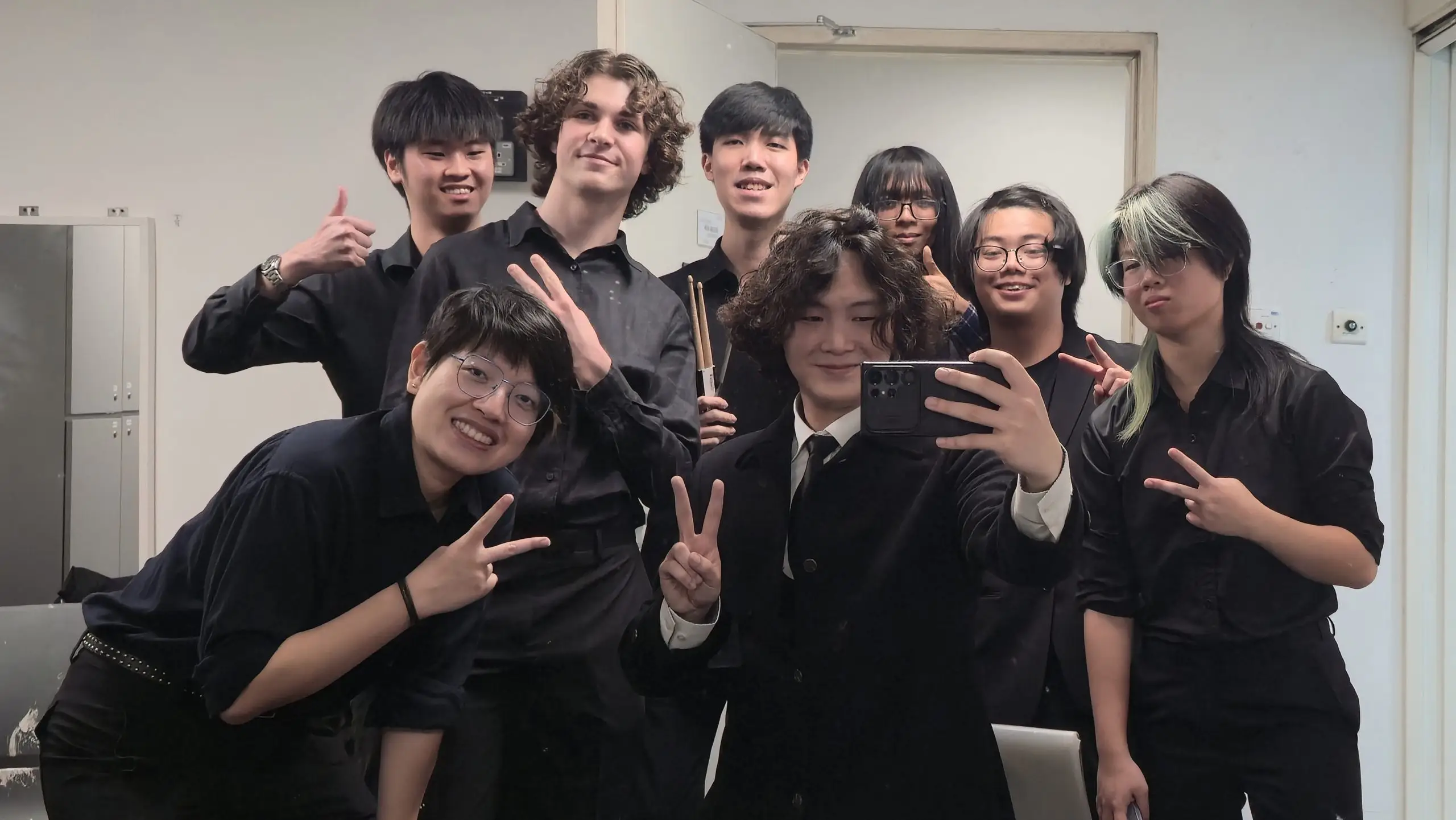
What to expect in LASALLE: BA (Hons) Music’s Ngiam Teo on composing for games, film and his own original epic
12 Aug 2026
For his final year project, Class of 2026 graduate Ngiam Teo presented Fleeting Worlds: For The Dawn, which tells the story of Zinnia, an ordinary girl who initially rejects her …
Trip report
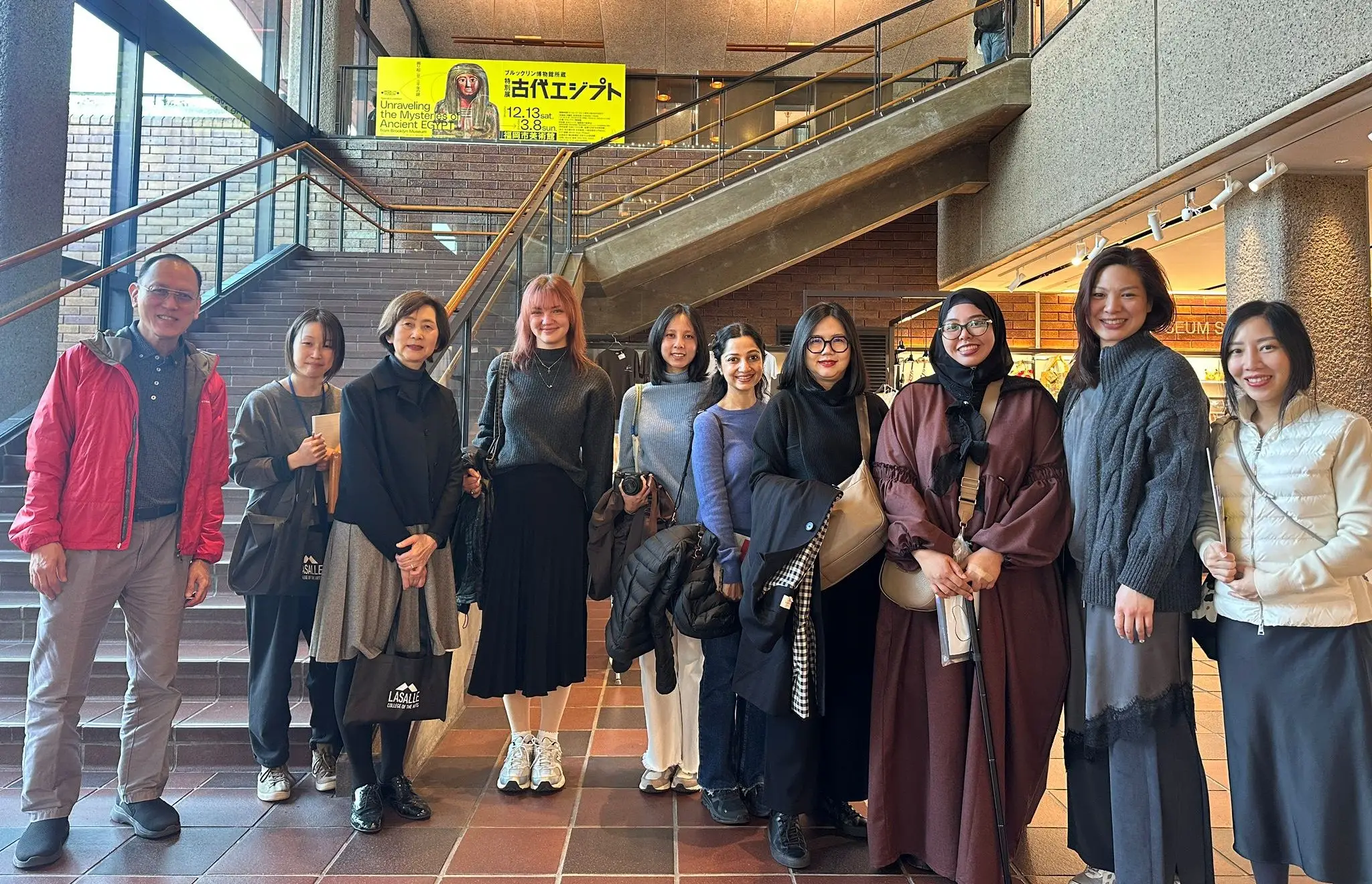
Memories of Museums, Matcha and mono no aware (物の哀れ): MA Asian Art Histories 2026 study trip to Fukuoka, Japan
4 Aug 2026
By Kendall Fosse and Aparupa Saha At the beginning of the academic year, when the 2026 cohort of LASALLE’s MA Asian Art Histories programme was told about a planned study …
What happens after art school
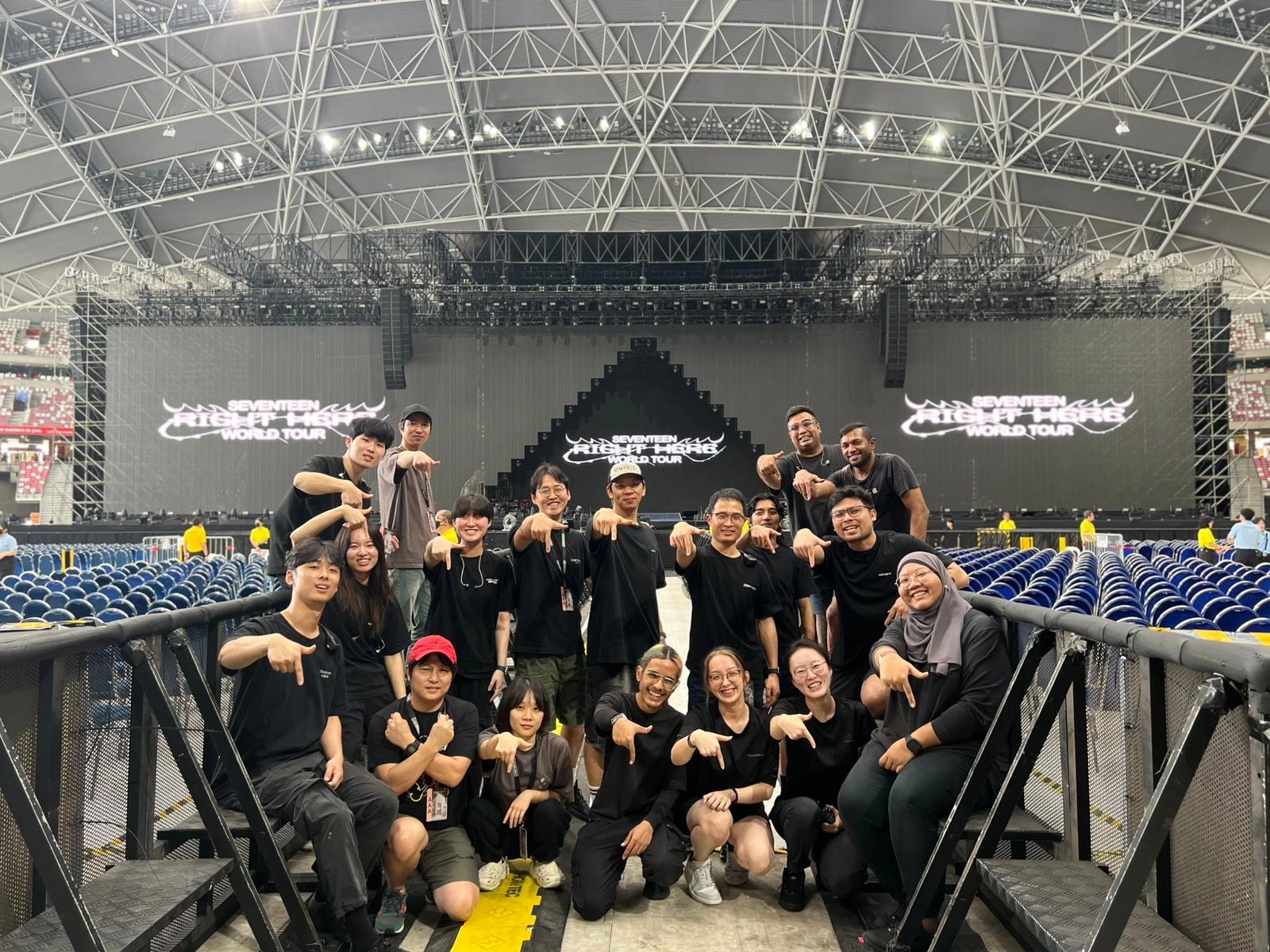
What happens after art school: Diploma in Audio Production alumna Hidayah Azman
3 Jul 2026
Sound engineer and Diploma in Audio Production alumna Hidayah Azman has worked with an impressive list of artists. Coldplay, Harry Styles, Imagine Dragons, Seventeen, Blackpink, Twice, Mayday and Jay Chou …
Trip report
BA (Hons) Arts Management students explore Dublin on COIL Plus+
3 Jul 2026
By Amila Khairana My Year 2 classmates, Vera Tan and Stella Ong, and I travelled to Ireland in June 2026 to participate in a prestigious research symposium organised by the …